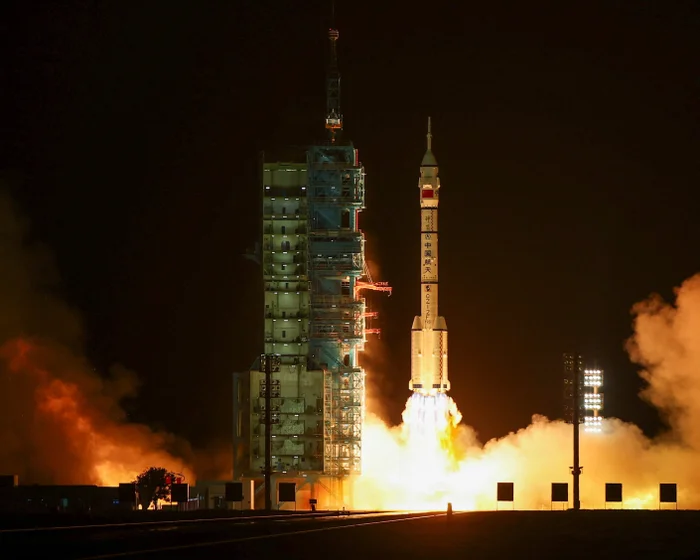
China has successfully launched a new crewed mission to its Tiangong space station, advancing the country’s long-term ambitions for human exploration of the Moon. Three astronauts arrived at the orbital outpost after the Shenzhou-23 spacecraft lifted off aboard a Long March-2F rocket from the Jiuquan Satellite Launch Center in the Gobi Desert late Sunday.
The spacecraft completed a rapid docking procedure in less than four hours, allowing the crew to board the Tiangong station, whose name translates to “Heavenly Palace.” The mission is commanded by veteran astronaut Zhu Yangzhu and includes former Air Force pilot Zhang Zhiyuan and payload specialist Lai Ka-ying, a former Hong Kong police officer who has become the first person from Hong Kong to travel into space.
The incoming crew was welcomed aboard by members of the departing Shenzhou-22 mission. The astronauts are expected to spend approximately six months on the station, carrying out scientific research, maintenance operations, and a series of spacewalks. However, one crew member will remain in orbit for more than a year as part of China’s first-ever long-duration mission designed to test the effects of extended stays in space.
Chinese officials say the Tiangong station is a central part of Beijing’s broader strategy to land astronauts on the Moon before 2030. According to the China Manned Space Engineering Office (CMSEO), the orbital laboratory allows scientists and engineers to gather valuable experience in long-term human spaceflight and test critical technologies needed for future lunar missions.
Agency spokesman Zhang Jingbo said upcoming missions involving the new Long March-10A heavy-lift rocket and the Mengzhou crew spacecraft will help verify systems required for crewed Moon landings. Multiple flights to the Tiangong station are planned over the next two years as part of the preparation process.
Despite increasing comparisons between China and the United States in the renewed race to the Moon, Chinese officials insist their program is not driven by rivalry. CMSEO senior engineer Zhou Yaqiang stated that Beijing is pursuing lunar exploration according to its own timetable and objectives.
“We are not competing with other countries in space,” Zhou said, adding that a future Chinese Moon landing would represent “a great feat for all of humanity.”
The last time humans landed on the Moon was during NASA’s Apollo 17 mission in 1972. Although the United States has revived lunar exploration through its Artemis program and recently completed another crewed flyby mission, China is rapidly expanding its capabilities with the aim of establishing a long-term presence beyond Earth orbit.
At the same time, Beijing has deepened cooperation with Moscow in the space sector. China and Russia have agreed to jointly develop projects related to lunar and deep-space exploration, including a shared data center focused on missions to the Moon and Mars.
In 2021, the two countries also unveiled plans for the International Lunar Research Station (ILRS), a proposed Moon base project. Russia has indicated it hopes to construct a nuclear-powered energy facility on the lunar surface within the next decade to support the future station’s operations.